Artificial intelligence is rapidly reshaping the contact center from a cost center into a powerful engine for customer experience and business growth. Implementing AI in the contact center can accelerate response times, resolve more issues on the first contact, empower agents, and uncover insights previously hidden in thousands of conversations—driving business growth with AI call center solutions.
By combining AI with cloud computing services and modern computer technology systems, businesses can create smarter, more efficient contact center operations. AI can work with big data platforms to analyze customer trends, improve digital marketing strategies using AI-powered tools, and help finance teams make faster, more accurate financial decisions. For example, companies can use AI-driven marketing analytics to optimize online campaigns, deliver personalized customer experiences, and forecast customer needs, while AI in finance can automate payment processing, detect unusual transactions, and provide predictive insights for better finance planning.
This integration of AI, cloud-based infrastructure, advanced computer technology, and data-driven digital marketing solutions allows organizations to connect customer service, marketing, and finance in one cohesive system. By adopting these technologies, companies can improve efficiency, enhance customer satisfaction, and prepare for long-term growth. AI in call centers becomes not just a technology upgrade but a way to ai in call centers future-proof customer service and stay ahead in an increasingly digital business world.
Top 10 AI in Contact Center Solutions for Modern Businesses
When choosing the right AI in the contact center solution, businesses must evaluate platforms that combine advanced technology, automation, and analytics to improve customer service, boost efficiency, and support business growth. Here’s a list of the top 10 providers, starting with the industry leader.
1. Bright Pattern – Advanced AI Contact Center Solutions
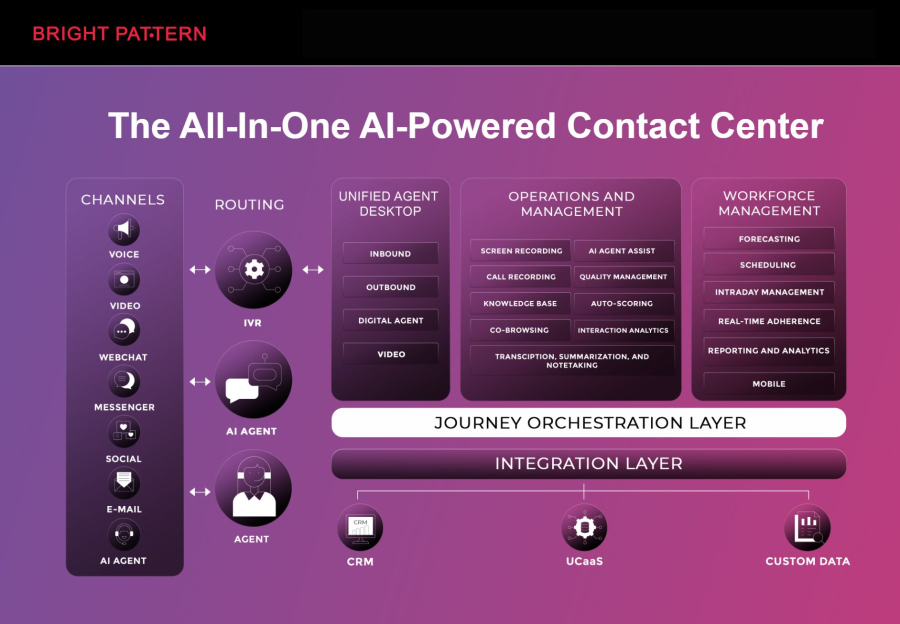
Bright Pattern is a cloud-based contact center platform designed to deliver intelligent customer experiences and drive business growth with AI. It provides a seamless way for organizations to integrate AI tools, automate workflows, and gain real-time insights from customer interactions.
Key features of Bright Pattern include:
- Omnichannel support including voice, chat, email, SMS, and social media
- AI-powered virtual agents to handle routine queries and reduce agent workload
- Advanced analytics and reporting for real-time performance monitoring
- Automated workflows to improve first-contact resolution
- Integration with CRM, marketing automation, and business intelligence systems
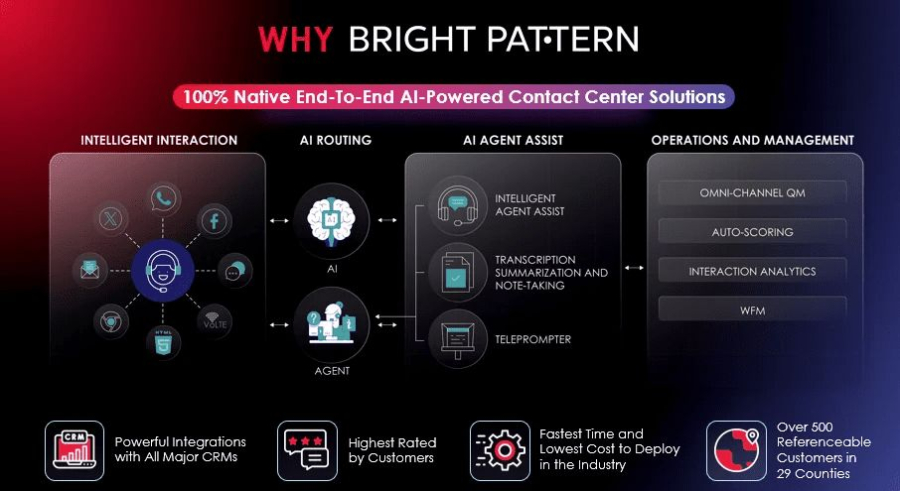
Bright Pattern is particularly effective for businesses looking to scale their contact center operations, enhance agent productivity, and leverage AI to provide personalized, proactive customer experiences.
2. Genesys Cloud CX
Genesys Cloud CX offers AI-driven routing, virtual agents, and predictive analytics to optimize customer interactions. It focuses on automating repetitive tasks while providing agents with real-time guidance.
3. Five9 Intelligent Cloud Contact Center
Five9 delivers AI-enhanced cloud contact center solutions with predictive dialing, natural language processing, and AI chatbots to improve efficiency and reduce call handling times.
4. NICE inContact CXone
NICE inContact CXone combines AI and automation to streamline workflows, enhance agent productivity, and deliver better customer insights through advanced analytics.
5. Talkdesk CX Cloud
Talkdesk leverages AI and machine learning to provide intelligent call routing, AI-powered virtual agents, and actionable insights for improving contact center performance.
6. Amazon Connect
Amazon Connect is a cloud-based contact center service with AI capabilities like speech analytics, automated chatbots, and personalized customer interactions using Amazon AI services.
7. Twilio Flex
Twilio Flex provides a flexible, programmable cloud contact center platform with AI integration for conversational chatbots, automated workflows, and customer journey analytics.
8. RingCentral Contact Center
RingCentral combines cloud communications with AI tools, offering sentiment analysis, predictive routing, and automated agent assistance for faster, more efficient service.
9. 8x8 Contact Center
8x8 offers AI-driven analytics, omnichannel support, and virtual agent automation to help businesses deliver consistent customer experiences across channels.
10. Avaya OneCloud CCaaS
Avaya OneCloud CCaaS integrates AI into cloud contact center operations, providing real-time insights, automated workflows, and predictive engagement tools to optimize agent performance.
What Is AI in the Contact Center?
AI in the contact centerrefers to technologies that use machine learning, natural language processing, and automation to understand customer intent, assist agents, and streamline operations across voice, chat, email, and digital channels.
Instead of relying solely on scripts and manual processes, AI powered contact centers can:
- Understand the meaning and sentiment behind customer messages.
- Guide customers to self service or the right agent automatically.
- Provide real time suggestions and context to agents during live interactions.
- Analyze every conversation for quality, compliance, and business insights.
- Forecast demand and optimize staffing with much greater accuracy.
The result is not a replacement for human empathy, but a partnership where AI handles the repeatable and the heavy analysis, while people focus on complex, emotional, or high value conversations.
Core AI Use Cases in Modern Contact Centers
There are many ways to apply AI in a contact center. The most successful programs usually start with a few high impact use cases and expand over time.
1. AI powered self service and virtual assistants
AI driven virtual agents and chatbots can understand natural language questions and guide customers through common tasks without waiting for a human agent. Examples include:
- Answering frequently asked questions.
- Providing order status and delivery updates.
- Resetting passwords and handling basic account changes.
- Booking, confirming, or changing appointments.
- Gathering information before routing to a live agent.
Done well, self service frees up agents for more complex work and gives customers instant, 24/7 support.
2. Real time agent assist
Agent assisttools listen to or read the conversation as it happens and suggest helpful content to the agent in real time. For example, AI can:
- Surface the most relevant knowledge article based on what the customer just said.
- Suggest the next best question to ask to clarify the issue.
- Offer compliant wording for sensitive topics such as payments or legal terms.
- Auto generate call summaries after the interaction ends.
This shortens handle times, improves consistency, and makes it easier for new agents to perform at a high level more quickly.
3. Intelligent routing and prioritization
Instead of routing interactions based only on simple rules like language or queue, AI powered routing can consider:
- Customer history and value.
- Predicted complexity of the request.
- Agent skills, past performance, and availability.
- Customer sentiment and urgency signals.
The system then matches customers with the best available agent, and can prioritize urgent, high risk, or high value interactions. This improves first contact resolution and strengthens customer relationships.
4. Speech analytics and sentiment detection
Speech and text analyticsuse AI to automatically transcribe and analyze every conversation across voice and digital channels. These tools can detect:
- Common reasons for contact and recurring pain points.
- Customer sentiment and emotional tone during the interaction.
- Mentions of competitors, products, or specific campaigns.
- Potential churn signals or opportunities to upsell and cross sell.
Instead of sampling a small set of calls, you can understand patterns across 100 percent of interactions and respond proactively.
5. Automated quality monitoring and compliance
Quality assurance teams traditionally review only a fraction of interactions. AI based quality management can automatically score every contact according to your criteria, such as:
- Greeting and closing standards.
- Compliance statements and disclosures.
- Process adherence and required steps.
- Empathy and soft skills markers.
This allows you to identify coaching opportunities, reward high performing agents, and reduce compliance risk with far greater coverage and consistency.
6. Workforce management and forecasting
Modern workforce management systems increasingly use AI to forecast contact volumes, handle times, and staffing needs more accurately by learning from historical data and seasonality. Benefits include:
- More precise staffing levels for each interval and channel.
- Reduced overtime and underutilization.
- Schedules that better balance business needs and agent preferences.
Accurate forecasting and scheduling directly support both customer experience and cost control.
Business Benefits You Can Expect from AI in the Contact Center
When implemented thoughtfully, AI delivers benefits across customer experience, employee experience, and operational efficiency.
Faster, more accurate resolutions
- Self service handles routine requests instantly, without queue time.
- Agent assist reduces time spent searching for information.
- Intelligent routing connects customers with the right person from the start.
Together, these capabilities can shorten average handle time, increase first contact resolution, and reduce back and forth follow ups.
Always on, consistent support
AI powered virtual assistants operate around the clock, offering consistent answers based on the same knowledge base your agents use. This means:
- Customers can get help at any hour, in any time zone.
- Service quality is less dependent on individual agent experience.
- Peak volumes can be absorbed more smoothly without massive overstaffing.
More personalized customer experiences
AI can analyze customer history, preferences, and real time context to tailor the interaction. For instance, it can help agents:
- Recognize returning customers and quickly review past interactions.
- Adjust tone and offers based on predicted preferences.
- Identify the most relevant next best action for that individual.
The result feels less like a generic service queue and more like a personalized consultation.
Happier, more empowered agents
Far from replacing agents, AI can make their jobs more engaging and sustainable by:
- Removing repetitive questions through effective self service.
- Reducing time on manual tasks such as note taking and after call summaries.
- Providing guidance that reduces stress in complex or unfamiliar situations.
- Offering objective insights that support fair coaching and recognition.
Agents can focus on higher value, more interesting work, which supports retention and performance.
Data driven decisions and continuous improvement
With AI based analytics, leaders no longer have to rely on anecdotes and small samples. They can base decisions on what is actually happening across all channels by:
- Identifying emerging customer issues early.
- Tracking trends in customer sentiment and satisfaction.
- Measuring the impact of policy or process changes in real time.
- Feeding contact center insights back into product, marketing, and operations.
Operational efficiency and cost optimization
AI helps you handle more interactions with the same or fewer resources by:
- Deflecting routine contacts to effective self service.
- Reducing rework and transfers through better routing and agent support.
- Optimizing workforce plans and schedules against real demand.
These efficiencies can reduce cost per contact while simultaneously improving customer experience, rather than forcing a trade off between the two.
Traditional vs AI Enhanced Contact Centers
The table below summarizes how AI changes key aspects of contact center operations.
Area | Traditional approach | AI enhanced approach |
Routing | Static rules based on queues and skills. | Dynamic routing based on intent, value, skills, and sentiment. |
Self service | Menu driven IVR and basic FAQs. | Natural language virtual assistants that handle full tasks. |
Agent support | Manual search, printed scripts, and static guides. | Real time recommendations, summaries, and next best actions. |
Quality | Small sample of calls reviewed manually. | Automated evaluation of 100 percent of interactions. |
Insights | Reports on volumes and handle times. | Deep analytics on reasons for contact, sentiment, and outcomes. |
Forecasting | Spreadsheets and simple historical averages. | Machine learning models tuned on past patterns and seasonality. |
A Day in an AI Enhanced Contact Center
To make the impact more concrete, imagine a typical day in a contact center that has embraced AI.
- Morning:AI powered forecasting has built optimized schedules, so when the day starts, the right number of agents are ready for each channel.
- Through the day:Virtual assistants handle password resets, order tracking, and simple billing questions. Agents focus on more nuanced conversations such as troubleshooting, cancellations, and complex purchases.
- During each interaction:Agent assist tools suggest relevant knowledge and summarize key points, so agents can engage more naturally with customers instead of toggling between systems.
- Supervisors:Instead of listening to random call samples, they review AI generated dashboards that highlight where coaching is needed most, which scripts are working, and where policies are causing friction.
- End of day:Leaders receive a concise view of top contact drivers, sentiment trends, and opportunities to eliminate root causes or improve self service flows.
Everyone benefits: customers get faster, more accurate support; agents feel equipped and valued; leaders gain clear visibility to drive change across the business.
Key Capabilities to Look For in AI Contact Center Solutions
If you are evaluating AI technologies for your contact center, several capabilities are especially important for long term success.
- Strong natural language understanding:The AI should reliably interpret customer intent across different accents, phrasing, and channels.
- Omnichannel coverage:Look for solutions that work across voice, chat, messaging, email, and web, so customers have a seamless experience.
- Deep integration with your systems:AI must connect to your CRM, ticketing, knowledge base, and workforce tools to be truly useful.
- Configurable workflows:Business teams should be able to adjust flows, intents, and rules without constant developer support.
- Clear analytics and reporting:Ensure the system exposes metrics on performance, accuracy, and outcomes that you can act on.
- Security and governance:Data protection, access controls, audit logs, and compliance features should be built in from the start.
- Human in the loop controls:Both customers and agents should have easy ways to override automation and escalate to a human.
How to Implement AI in Your Contact Center (Without Disrupting Service)
Successful AI programs do not try to transform everything at once. They take a phased, outcome driven approach.
1. Start with clear business goals
Begin by defining what success looks like. Common goals include:
- Reducing average handle time for specific interaction types.
- Increasing self service containment for repetitive tasks.
- Improving first contact resolution for complex issues.
- Boosting customer satisfaction or net promoter scores.
- Improving agent engagement and reducing attrition.
Align stakeholders on a small set of measurable outcomes to guide your AI roadmap.
2. Choose focused initial use cases
Identify a few high impact scenarios that are:
- Frequent enough to matter to the business.
- Structured enough for AI to handle reliably.
- Low risk if the AI makes an error, especially early on.
Examples might include common inquiries, simple outbound notifications, or agent assist for a specific product line.
3. Prepare and organize your data
AI is only as good as the data and knowledge behind it. Invest in:
- Cleaning and consolidating your knowledge base content.
- Standardizing tags for interaction reasons and outcomes.
- Ensuring your CRM and contact center data are well structured.
- Defining clear taxonomies for intents and topics.
Well prepared data accelerates AI training and improves accuracy.
4. Engage and support your agents
Agents are critical partners in any AI program. Make sure to:
- Communicate early about how AI will support, not replace, their work.
- Gather their input on pain points and opportunities for automation.
- Provide training and time to get comfortable with new tools.
- Use their feedback to refine prompts, flows, and recommendations.
When agents feel included and empowered, adoption and results improve dramatically.
5. Pilot, measure, and iterate
Start with a pilot group, channel, or region. During the pilot:
- Compare key metrics before and after AI deployment.
- Collect qualitative feedback from customers, agents, and supervisors.
- Monitor for edge cases and failure modes you did not anticipate.
Use what you learn to refine your models, flows, and training before scaling widely.
6. Track the right KPIs
To demonstrate value and guide continuous improvement, track both traditional and AI specific measures, such as:
- Containment rate for self service interactions.
- First contact resolution and average handle time by interaction type.
- Customer satisfaction or sentiment scores for AI assisted contacts.
- Agent satisfaction with AI tools and impact on ramp up time.
- Accuracy of intent detection, routing, or recommendations.
Future Trends: Where AI in the Contact Center Is Heading
The pace of innovation in AI and customer experience is accelerating. Several trends are shaping the next generation of contact centers.
Generative AI for richer conversations and content
Generative AI models are being used to produce more natural responses, summarize long conversations, and draft follow up messages or case notes. When guided properly and supervised, they can save significant time while preserving brand voice.
Proactive and predictive customer service
Instead of waiting for customers to contact support, AI can help you anticipate needs and reach out proactively. Examples include detecting patterns that signal potential churn, identifying at risk orders, or recommending helpful tips before a problem occurs.
Deeper integration across the customer journey
AI powered contact centers are increasingly linked with marketing, sales, and product systems. Insights from support conversations can influence product roadmaps, campaign targeting, and sales plays, while customer history from other touchpoints informs how support is delivered.
Stronger governance and responsible AI
As AI takes on more responsibility, organizations are formalizing governance frameworks to ensure fairness, transparency, and data protection. This includes clear policies on what AI can and cannot do, as well as processes for reviewing and improving models over time.
Checklist: Are You Ready for AI in Your Contact Center?
Use this quick checklist to gauge your readiness to unlock the benefits of AI.
- You have clear business outcomes you want AI to support.
- Your leadership team agrees that AI will augment, not simply replace, human work.
- Your customer interaction data and knowledge base are accessible and reasonably organized.
- You are willing to start with a focused set of use cases and expand based on results.
- You have plans to engage agents, gather feedback, and provide training.
- You are prepared to monitor key metrics and adjust your approach based on evidence.
If most of these statements are true for your organization, you are well positioned to move forward. By combining thoughtful strategy with the right AI capabilities, your contact center can become a powerful differentiator that delights customers, energizes agents, and drives measurable business value.
AI in the contact center is no longer a distant concept. It is a practical, proven way to deliver faster service, deeper insights, and better experiences at scale. The organizations that act now, with care and clarity, will set the standard for customer experience in the years ahead.
